Welcome to the homepage for the 2025 UC Open Source Contributor Survey! Here you’ll find all the artifacts associated with this study, a summary of what it’s all about, and updates on our ongoing research.
Summary and key findings
Open source is an approach to software development that allows others to reuse the source code and build their own program from it. Many open source projects also welcome community contributions to the codebase. Much if not most academic software is open source, but university policies, services, and impact metrics often overlook the needs and accomplishments of open source developers.
In May 2025, the UC OSPO Network conducted a survey to shed light on open source activity at the University of California and to identify opportunities for increased support. We received 294 responses from experienced or aspiring open source contributors across ten UC campuses, a group that included students, faculty, and staff.
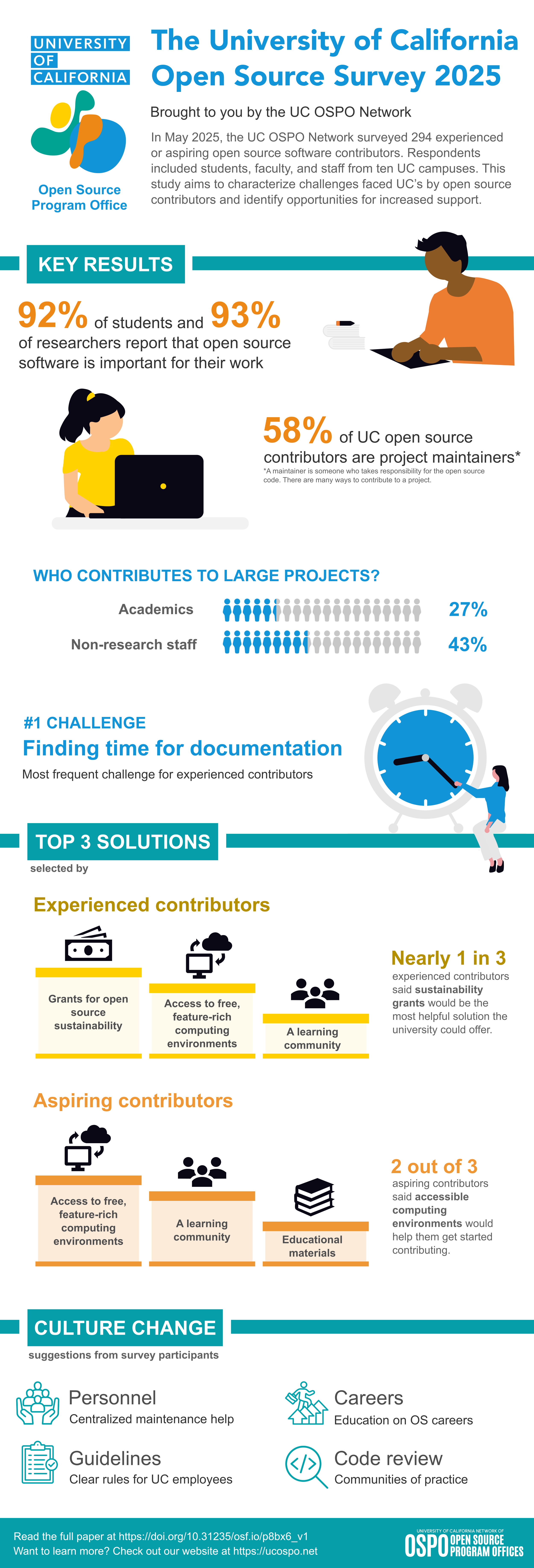
Contents of the infographic.
The University of California Open Source Survey 2025. Brought to you by the UC OSPO Network. Key results:
92% of students and 93% of researchers report that open source is important for their work.
58% of UC open source contributors are project maintainers.
27% of academics and 43% of non-research staff occasionally or frequently contribute to large projects.
The number one challenge, that is, the most frequent challenge for experienced contributors, was finding time for documentation.
A diagram shows the top three solutions preferred by experienced contributors and aspiring contributors. The top three solutions preferred by experienced contributors were:
grants for open source sustainability
access to free, feature-rich computing environments, and
a learning community.
The top three solutions preferred by aspiring contributors were:
access to free, feature-rich computing environments,
a learning community, and
educational materials.
Other forms of support proposed by survey participants include:
Personnel: centralized maintenance help;
Careers: education on open source careers;
Guidelines: clear rules for UC employees;
Code review: communities of practice.
We found that the vast majority of students and researchers consider open source software to be important for their work. We also found that the majority of open source contributors at UC are project maintainers, meaning they are the primary stewards of a project. Despite the importance and prevalence of open source software, about one-third of respondents reported that they have shared their code on custom websites, indicating that a large body of academic software is not located in standard repositories. Contributors face many challenges in terms of resources, computing infrastructure, and institutional culture. At the same time, the abundance of maintainers and the prevalence of time and funding-related challenges underscore a critical need for support for maintenance costs and overall sustainability of open source software.
Advice for Open Source Program Offices (OSPOs)
The most common challenges that emerged from our study were time and funding. As such, OSPOs should consider either directly funding open source, or consider creative ways to “give back” time or money. Examples might include facilitating co-working groups, promoting AI tools for documentation, or providing support for external grant acquisition.
We encountered high demand for affordable, accessible, feature-rich computing environments. This suggests an opportunity for academic OSPOs to help secure the technical infrastructure needed for open source development.
Comments revealed three broad categories of concern: Resources, Infrastructure, and Culture. OSPOs should foster an institutional culture where open source activities are not merely monitored or regulated, but also supported, celebrated, and rewarded.
Project status
We intend to continue deploying improved versions of this survey at UC again in the future, perhaps every two years. If you deploy an open source survey at your campus or in your academic community, we’d love to hear about it, whether or not you used our survey instrument.
As part of the survey, we gave respondents the opportunity to share their GitHub (GitLab, etc.) usernames with us. We plan to use these data to investigate where, how, and how often UC contributors are contributing to small and large open source repos. This may happen in the second half of 2026.
If you are interested in collaborating with us on this or on another research
effort, please reach out to us at
ospo@library
Links to research products
Preprint: Scarlett et al. (2026)
To find the preprint’s supplementary materials, you have to go the ‘Project’ in OSF that has the same title as the preprint. Find it here: osf
.io /m5ft6 /overview
The data will be here*: doi:10
.5061 /dryad .2280gb662 An archived snapshot of the code will be here*: doi:10
.5281 /zenodo .17783102 *These two DOIs will be functional after peer review. Please contact the authors if access is needed sooner.
Living code repository: UC
-OSPO -Network /ospo -survey -analysis Survey instrument is available as a PDF in the preprint’s supplementary materials and in the GitHub repo. It will also available in .docx and .qsf formats in the Dryad dataset.
Lessons learned, a retrospective on the survey instrument: lessons_learned.md
- Scarlett, V., Curty, R. G., Gomez, J., Langdon, L., Janée, G., & Budden, A. E. (2026). A system-wide snapshot: A multi-campus survey of open source contributors at the University of California. Center for Open Science. 10.31235/osf.io/p8bx6_v1